Something that I have noticed in common across all my projects in consulting so far:
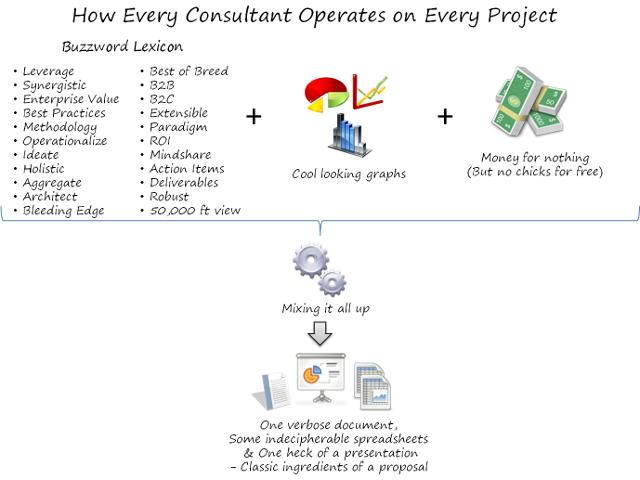
There is obviously a market for a proposal generator. Wonder when someone will come up with the consulting equivalent of SCIgen’s “An Automatic CS Paper Generator“.
Sayontan Sinha's Feeble Attempts to Stay Objective
Something that I have noticed in common across all my projects in consulting so far:
There is obviously a market for a proposal generator. Wonder when someone will come up with the consulting equivalent of SCIgen’s “An Automatic CS Paper Generator“.
As a kid I remember watching the Friday night 10:00 PM TV program on Doordarshan called “The World This Week”. It was a very good program – a weekly news update about events outside India, telecast in a very western manner, significantly more engrossing than the rather staid staple news programs of DD. An enduring picture that remained stuck in my mind for years was that of a girl running naked from a site attacked with Napalm. A few months back I turned to my favourite hunting ground, the internet, for finding out who that person was and what happened to her. It wasn’t difficult – Wikipedia had a story about her and National Public Radio actually had her speaking. Phan Thị Kim Phúc, or Kim Phuc or simply Phuc lives in Toronto with her husband and two children. She runs an organization called Kim Phuc Foundation International, which aids children who are war victims.

From her talk on NPR:
On June 8, 1972, I ran out from Cao Dai temple in my village, Trang Bang, South Vietnam; I saw an airplane getting lower and then four bombs falling down. I saw fire everywhere around me. Then I saw the fire over my body, especially on my left arm. My clothes had been burned off by fire.I was 9 years old but I still remember my thoughts at that moment: I would be ugly and people would treat me in a different way. My picture was taken in that moment on Road No. 1 from Saigon to Phnom Penh. After a soldier gave me some drink and poured water over my body, I lost my consciousness.
Several days after, I realized that I was in the hospital, where I spent 14 months and had 17 operations.
It was a very difficult time for me when I went home from the hospital. Our house was destroyed; we lost everything and we just survived day by day.
Kim Phuc later recuperated and became the symbol of the war. Richard Nixon once doubted the authenticity of this Pulitzer Prize winning photograph – it was so iconic.
A few years after The World This Week I caught another picture, this time on a rerun of a story from the National Geographic. This picture is now famous as the Afghan Girl and it became the inspiration for people to volunteer and help out at the Afghan refugee camps.

At the time of this photograph the author of the story in National Geographic Debra Denker did not know the name of this girl with arguably the most haunting pair of eyes ever seen. The focus of the article being more on the ravages of the Afghan war of that time, the identity of this person was not paid much attention to. However, the photo was so captivating that many years later, after the 9/11 attacks in 2001, a team from National Geographic made an earnest attempt to track her down. Cathy Newman reported the new story in April 2002, with a second photograph, again by Steve McCurry.

The name of the girl is Sharbat Gula or Sharbat Gul, depending on whether you read the story or listen to the narrative about how they tracked her down. Though Sharbat Gula means rose sharbat (sharbat being a drink of water with some sweet things added), I am tempted to believe that the name was actually Sharbat Gul, because not only is Gul a more authentic surname, but her husband’s name is Rahmat Gul too.
Sharbat, when National Geographic photographed her a second time was living with her husband and 3 daughters. Though the face had aged over the 17 years, the eyes still had that same piercing look. This time National Geographic ensured that Sharbat and her family received the aid.
Way back in early 2004 I made a trip to Seattle to visit my good friends Alok and Shruti. Here I was introduced to this board game called Carcassonne, which I really liked. Carcassonne is based on a simple concept – territory expansion. You pick tiles and you have to place them on a flat surface in a contiguous manner, trying to build cities, roads, monasteries. Obviously the person with the biggest territory wins. To win your strategy has to be really good and of course, you need to have some luck.
When I decided to purchase this later, Amazon showed me a related game called The Settlers of Catan. The game was not generally available at that time and I checked all stores that I was aware of. Eventually I purchased it from the manufacturer (MayFair Games) at somewhat of a premium. Now, a common theme with me is that whenever I purchase something that is not easily available, I tend to do nothing with it for the longest possible time. To provide you with an example, as an amateur philatelist I was really keen on laying my hands on a Penny Black. I eventually managed to get it, but I just stashed it away in a box somewhere and didn’t look at it again. The same happened with Catan – I had opened the packaging, tried to understand the game and given up after seeing the volume of information that I had to go through. And so the box lay at home, gathering dust.
Then a few nights back our friends Vaibhav and Swati decided to come over for a get-together with a plan to play Catan. The intent was to start early, so there were at our place by 5:30 in the evening. However I had a rather bad weekend with so much work to be done that I only freed up at around 9:00 pm on Sunday. And that is when they explained the rules. I must say that the rules seemed every bit as complicated as they had the first time. We decided to do a trial run and from that moment Tanuka and I were absolutely hooked.
Catan again deals with territory building, but in a slightly different manner. For one, a game of Carcassonne can last upto an hour at the most. Catan on the other hand lasts for at least a few hours. In fact we ended up playing for four hours without completing the game and eventually called it quits. The standard game of Catan can be played with 3-4 players. You get an extension for 5-6 players as well, if you want to support more players: The Settlers of Catan 5-6 Player Extension


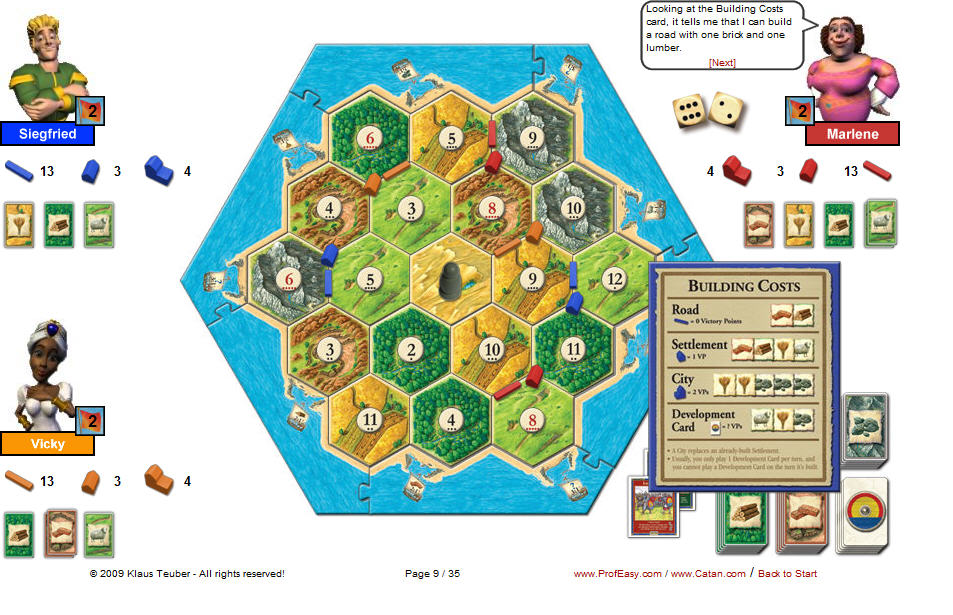
The objective is to colonize Catan, a newly discovered island. The person who manages to score 10 points by means of settlements is the winner. In the simplest sense the game has two parts – Board Setup, and Gaining Resources and Earning Points:
As you can see, the rules do appear complex. Apparently the founder Klaus Teuber had planned a much more complex game to start with, but after revisions finalized on the current form. I have to add, though, that once you play the game the rules appear much more simple. I have only played this twice and by the second time I had a full understanding of the rules. Tanuka loved the game too. Just to give you an insight of how much we liked it, I have gone ahead and placed orders for the 5-6 player extension as well as the the Cities and Knights expansion. We tried playing Monopoly
I had earlier expressed my chagrin about how Union Carbide, Dow and the former chairman of Union Carbide Warren Anderson have made the Bhopal Gas Tragedy an absolute farce of capitalistic proportions. Imagine my surprise when I came across this rather interesting movie, “The Yes Men Fix the World” on HBO last night. The movie depicts how a team of two pranksters, Andy Bichlbaum and Mike Bonanno (real names Jacques Servin and Igor Vamos), calling themselves the “Yes Men” played elaborate pranks on some of the major greedy corporate giants of the world.
I had read about this movie being released and Dow and ExxonMobil slamming it a few days back, but I did not expect to catch it so soon on TV. Nevertheless it was worth a watch. Perhaps the most spectacular indictment was that of Dow. On the 20th anniversary of the Bhopal tragedy on 3rd December 2004, Andy posed as Jude Finisterra, a Dow Chemical spokesperson and went live on BBC World, claiming that Dow had decided to liquidate Union Carbide and hand off the $12b proceeds for medical care, site cleanup and funding research into the hazards of other Dow products.
Andy then appeared in another BBC interview on Dow after the story had been discredited and was quizzed repeatedly about toying with the sentiments of the Bhopal victims. Curiously the interviewer’s focus was not on the fact that Dow hadn’t done the right thing. The movie proceeds to show that Andy and Mike traveled to Bhopal, met with people and social activists there and tried to find out if they had caused the people more harm than good. As per the movie they did not (but I am guessing that they probably edited the uncharitable parts)
There are a lot of other pranks shown, like one about Exxon recycling the remains of victims of a toxic spill to make “Vivoleum” candles, high-level Halliburton executives agreeing to a SurvivaBall, “designed to protect the corporate manager no matter what Mother Nature throws his or her way”, pulling a fast one on New Orleans mayor Ray Nagin and so on.
All in all, the movie is a fine watch. The really horrifying parts of it are the very insensitive remarks made by different people regarding different disasters, natural or man-made. People’s talking about how to take advantage of others’ suffering goes to show where the priorities of people lie. Go ahead and watch it if you can!
PS: I have been working so hard on my blog that I have stopped posting! I am currently working on the next release of Suffusion, something a lot more customizable. Keep watching!
I am happy to announce that my first serious foray into themes has gotten somewhere. The theme used by my blog currently is something that I developed (as mentioned in my last post). I submitted this on the official WordPress site on Friday and it got accepted as the 917th theme on the site after some really minor mods (I wasn’t aware that I had to explicitly GPL it). So there you have it. The theme is available at http://wordpress.org/extend/themes/suffusion. The official page for this theme is on my Aquoid Themes announcements.
Feel free to shoot across bug reports, feature requests and general comments. Bouquets and brickbats will be accepted with equal grace!
After my dalliance with Gallery2 and not being really satisfied with it, I was on the lookout for a better photo management software for my website. Don’t get me wrong – Gallery2 is good, but it felt too heavy for my use, and the Smarty templates were not helping either.
After some hunting, and having considered options like Coppermine and PixelPost, I went with one of my old candidates – Zenphoto. My initial gripe about ZP was that I couldn’t customize it. However, I realized that I was being asinine about it. All I needed to do was rather than run the Dreamhost “One-Click Install”, I needed to manually unzip the files and configure the software by hand. Small fry. I had the software up and running in a matter of minutes.
I found it pretty easy to customize ZP, given that the structure is fairly intuitive. Take a look. I have almost managed to get it to work to my expectations, with a few minor UI tweaks remaining. Additionally I want to investigate using Cooliris’ PicLens for the slideshows because they are hyper-cool. I know I need to use a Media RSS file, but somehow the ones on the web that already have been developed don’t work for my version of ZP. So for the moment I am using the standard JQuery based slideshow, while I will continue to work on an appropriate Media RSS generator and a somewhat better slideshow capability.
This brings me to my next topic – my current WordPress theme. I call it Green Light and I have been using it for a couple of weeks now and I like the way it has shaped up. I am planning to release this on the official WordPress themes site. Before I do so I would like to solicit your feedback regarding things that you believe I should improve here. Comments regarding color schemes, icons, aesthetics, layouts etc are most welcome. Note that this theme doesn’t have options enabled.
Ciao.
Update on 30th July 2009:
I submitted the WordPress theme. Let’s see if it gets accepted. I had to rename the theme, though, because someone already had taken “Green Light”, so my theme is now called “Suffusion”.
The 2000 movie Memento happens to be a favourite among viewers and with good reason. At the time of writing it is #29 on IMDB’s top 250.
If you are not familiar with Memento, do try to watch it, and with full attention. It takes a very innovative concept and turns it even more innovative. The protagonist Leonard Shelby discloses at the start of the tale that he suffers from anterograde amnesia (short term memory loss). He remembers that in an attack his wife was mortally wounded and the injury that he suffered on his head caused this condition in him. He remembers things before the attack, but cannot hold on to things happening after the attack. The story proceeds to show how he tracks down his wife’s killer. And that is where the fun begins. The director and screenwriter use three plot devices – a reverse chronological thread, a chronological series of flashbacks and an intuitive way of creating memories for a man with none.
Within 10 minutes you realize that the story is being told in a reverse sequence – first you see the last 5 minutes of the story, then you see the 5 minutes preceding it, then you see the 5 minutes before that, and so on. This way, what you see at the end is actually the beginning of the story. You also see Leonard taking polaroid shots of people and scenes that he comes across, then jotting down important things on the photos. Additionally he gets important information tattooed on himself. This way he creates memories that he can hold on to. What you also see is the story of Sammy Jankis, one of Leonard’s former clients and a victim of anterograde amnesia.
Obviously, when you have a story being told in this manner, you are in for a surprise at the end. And in compliance with my unspoken policy I will not spoil that end for you.
Memento got a lot of kudos at the time of its release, because of the innovative reverse-chronological style of story telling. However, when I first heard of the story, I knew that the narrative style wasn’t entirely original. Back in college I had borrowed a science fiction collection from the hostel library and that had a short story of which I could recollect the two supporting characters – Tharn and a robot. Neither Google nor Wikipedia were very helpful, since I couldn’t recollect the name of the book, the name of the story or the story’s author. After several aborted attempts I finally had success today.
Typically I tend to remember the names of a few short stories in a collection. In this case, given that I had read the book more than 12 years back, and given that I had read several books around the same time, my memory was clouded. But eventually I did manage to recall one story – “Brightside Crossing”. I knew earlier that Asimov’s “Nightfall” was in this collection, but then that short story is a part of several collections. A Google search gave me the link to a collection called Beyond Tomorrow – 10 Science Fiction Adventures and I immediately knew I had struck gold. There was one story in this book called “Happy Ending” by Henry Kuttner. This was what I was looking for.
Turned out that Wikipedia did have an entry for this:
“James Kelvin pushed the button on the device the robot had given him. He was instantly transported to the chemist with the red moustache, who exclaimed, ‘Where have you been? I patented those medicinal formulas you gave me, and they are easily worth several millions of dollars. We will both be healthy, famous and rich!'” This was the happy ending to the story of that name about James Kelvin (by Henry Kuttner, 1949). But it is also the first paragraph of the story! Now it continues with the beginning of his tale, and by the end of that beginning, the reader receives a nasty jolt, as every assumption of the happy ending is turned inside out by the truth.
As you can see, there is no mention of either Tharn or a robot, which indeed makes it more difficult to locate this story! However, armed with this information I did manage to get some excerpts:
This is the way the story ended:James Kelvin concentrated very hard on the thought of the chemist with the red moustache who had promised him a million dollars. It was simply a matter of tuning in on the man’s brain, establishing a rapport. He had done it before. Now it was more important than ever that he do it this one last time. He pressed the button on the gadget the robot had given him, and thought hard.
Far off, across limitless distances, he found the rapport.
He clamped on the mental tight beam.
He rode it …
The red-moustached man looked up, gaped, and grinned delightedly.
“So there you are!” he said. “I didn’t hear you come in. Good grief, I’ve been trying to find you for two weeks.”
“Tell me one thing quickly,” Kelvin said. “What’s your name?”
“George Bailey. Incidentally, what’s yours?”
But Kelvin didn’t answer. He had suddenly remembered the other thing the robot had told him about that gadget which established rapport when he pressed the button. He pressed it now – and nothing happened. The gadget had gone dead. Its task was finished, which obviously meant he had at last achieved health, fame and fortune. The robot had warned him, of course. The thing was set to do one specialised job. Once he got what he wanted, it would work no more.
So Kelvin got the million dollars.
And he lived happily ever after …
This is the middle of the story:
As he pushed aside the canvas curtain something – a carelessly hung rope – swung down at his face, knocking the horn-rimmed glasses askew. Simultaneously a vivid bluish light blazed into his unprotected eyes. He felt a curious, sharp sense of disorientation, a shifting motion that was almost instantly gone.
Things steadied before him. He let the curtain fall back into place, making legible again the painted inscription: HOROSCOPES – LEARN YOUR FUTURE – and he stood staring at the remarkable horomancer.
It was a – oh, impossible!
The robot said in a flat, precise voice, “You are James Kelvin. You are a reporter. You are thirty years old, unmarried, and you came to Los Angeles from Chicago today on the advice of your physician. Is that correct?”
…
This is the way the story starts:
Quarra Vee sat in the temporal warp with his android Tharn, and made sure everything was under control.
“How do I look?” he asked.
“You’ll pass,” Tharn said. “Nobody will be suspicious in the era you’re going to. It didn’t take long to synthesise the equipment.”
“Not long. Clothes – they look enough like real wool and linen, I suppose. Wristwatch, money – everything in order. Wristwatch – that’s odd, isn’t it? Imagine people who need machinery to tell time!”
“It’ll be safer. The optical properties in the lenses are a guard you may need against mental radiations. Don’t take them off, or the robot may try some tricks.”
“He’d better not,” Quarra Vee said. “That so-and-so runaway robot! What’s he up to, anyway, I wonder? He always was a malcontent, but at least he knew his place. I’m sorry I ever had him made. No telling what he’ll do in a semi-prehistoric world if we don’t catch him and bring him home.”
…
Note that the texts “This is the way the story ended”, “This is the middle of the story” and “This is the way the story starts” are in the original text and are not my embellishments. Obviously I have left out the main story, but the author does the decomposition into three parts, giving the last part first, the middle part next and the beginning last. And obviously you are in for a shock at the end. This story was first published in the “Thrilling Wonder Stories” August 1948 edition, so it predates Memento by more than half a century. And apart from the reverse chronological setting there is brainwashing involved too.
Memento takes this concept up a few notches and splits the sequence into several sections, thereby adding scope for unpredictability in each section. That is where its novelty lies – not in the reverse chronology itself.
I was putting together a list of things that none ever gives a second thought to. Here is what I came up with:
Can you think of any more?
Following my article about the Harry Potter series I have decided to write another summary, this time of Terry Goodkind’s Sword of Truth series. Before I begin, a few words about books and me. I love books, though I am not obsessed with them. On an average I read around 12-15 novels a year. That translates to approximately 1 a month. Of course, it doesn’t mean that I read one every month – it is entirely likely that all the novels are finished in the span of 2 months. I have a pretty decent collection of books, running close to a thousand.
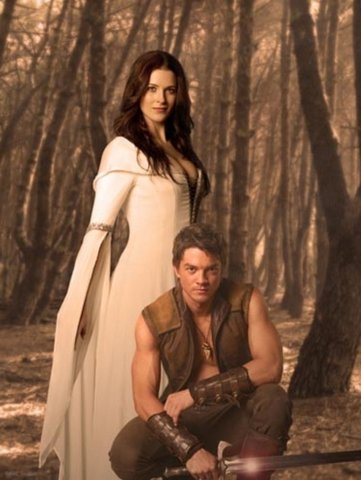
My foray into fantasy was fueled by a K-Circle quiz in 2003, Harry Potter and LOTR notwithstanding. I decided to try out the books that happened to be the answers of the quiz and took recommendations from my good friend Vishy. Vishy suggested that I try the book Wizard’s First Rule from the Sword of Truth series. And I was hooked. If I might add, Vishy stopped following the series through the middle of the third book (Blood of the Fold), but I went on to read the entire series of 11, plus the prequel Debt of Bones. The series has been adapted to a TV series called Legend of the Seeker. The challenge of adapting a book for the idiot box is that you have to make things formulaic, whack some events out of sequence, introduce your own elements and drop a few others. Keeping these in mind the Legend of the Seeker comes off as an attempt that is not very satisfactory. More of it later. But I must add that they have a rather pretty leading lady in Bridget Regan.
The Character Universe
Each book mentions one Wizard’s rule
- Wizard’s First Rule: People will believe a lie because they want to believe it’s true, or because they’re afraid it might be true.
- Wizard’s Second Rule: The greatest harm can result from the best intentions.
- Wizard’s Third Rule: Passion rules reason.
- Wizard’s Fourth Rule: There is magic in sincere forgiveness; in the forgiveness you give, but more so in the forgiveness you receive.
- Wizard’s Fifth Rule: Mind what people do, not only what they say, for deeds will betray a lie.
- Wizard’s Sixth Rule: The only sovereign you can allow to rule you is reason.
- Wizard’s Seventh Rule: Life is the future, not the past.
- Wizard’s Eighth Rule: Talga Vassternich. (Deserve Victory)
- Wizard’s Ninth Rule: A contradiction can not exist in reality. Not in part, nor in whole.
- Wizard’s Tenth Rule: Willfully turning aside from the truth is treason to one’s self.
- Wizard’s Eleventh Rule: The “Rule Unspoken”, the “Rule Unwritten”, “The rule from the beginning of time.”
Each rule is explained in the context of the story. The last rule is particularly interesting and is not explicitly quoted. However Richard figures it out and that is instrumental in his victory at the end.
The books are quite captivatingly written. I recall starting the first book and turning the pages in excited anticipation of what was going to happen next. I didn’t rest till I had finished the book at around 4:30 a.m. That being said, there is a lot of gore and violence at several places, along with talk of rape and abuse in every novel. However, if you are not squeamish about such things then you will enjoy the ride. You have to be careful, though, about giving the books to younger kids. Another aspect of the book is the angst. The lead characters never spend much time happily with each other – they are almost always separated by some machination.
And now for the books themselves. I am keeping my reviews as spoiler-free as I can. As a result I am leaving out key plot details and character traits at several points.
The structure of the story is like most other works of fantasy – the young hero finds out that he is blessed and has to save the world, the odds are insurmountably stacked against him, he has a kindly mentor to help him in his quest and the villain is a nasty piece of work. However, what makes the difference is Goodkind’s deftness with words. The details about violence are graphic enough and scenes of angst are drawn out to just the right limit, so as to not only prevent the reader from getting bored, but also to paint the correct picture in the reader’s head. What works very well is the way the characters are fleshed out. If anything is wrong, it is the fact that the names are somewhat corny. Darken Rahl? More laughably, Panis Rahl?
If you are old school (which is the school I like to think I belong to) you are bound to have an old fashioned home page that predates your blog. You probably have a site map / link structure and a good enough page rank, which gives you incentive to continue to maintain your home page in addition to your blog. A problem that I faced was regarding linking of my static old pages through my blog. WordPress provides two ways to define and access such static content:
There seem to be two options to take care of the linking between the static website and the dynamic blog:
I then came across a plug-in called Redirection. This plug-in is very feature-rich and the very simplest thing it lets you do is to define a source URL and a target URL to redirect to. Using this feature you can very easily set up all the links in your blog and ensure portability. Here is what you do:




That’s it – you are done. The next time someone tries to get to http://mynethome.net/blog/old-page/, the link will be forwarded to http://mynethome.net/original-page.php. If your theme, like most half-decent themes, displays Pages in the header, “Old Page” will show up there and you will be able to click on it to go outside your blog. If your theme doesn’t display pages in the header you could always use a widget on the sidebar.